Adjustable Document Cameras Became the Category Baseline — Not an Upgrade
What changed in buyer behaviour between 2019 and 2025, and what it means for anyone sourcing container volumes.
Before roughly 2019, most document cameras were sold as fixed-arm devices. Purchase specifications were written around sensor resolution, auxiliary lighting and output connectors, because the buyer — usually a school board or a government department — was thinking about installation, not about daily handling. That era is over. When the same unit now has to serve a Year 6 classroom in the morning, a bank service counter in the afternoon and a sales engineer's hotel room the following week, procurement committees have started to treat mechanical adjustability as a primary specification rather than a cosmetic detail.
What does adjustability mean in engineering terms? It means a damped hinge that still holds its position after 5,000 cycles. It means a camera head that rotates 360° without tools. It means the cable runs inside the column so it cannot snag a page being turned. And it means a base that can be screwed to the edge of a counter instead of relying on a single adhesive pad. Those four requirements now appear in a growing share of the enquiries we receive from educational resellers and system integrators — and they are the four points on which cheap imports most often fail field trials.
Here is a sourcing insight most catalogues will not give you: in the wholesale return rate for document cameras, joint failure outranks sensor failure and optical defects. Friction hinges of the kind found on low-cost units gradually sag under their own weight, the frame drifts, and the end user simply reports "the camera is broken". This is why our own purchase team evaluates hinge type — and whether the factory publishes cycle-test data — before it evaluates whether the sensor is 13MP or 8MP.
At channel level, the shift is just as visible. Five years ago a distributor bought an A3 visualizer for schools, an A4 scanner for bank counters and a book scanner for libraries as three separate product lines. Today the same purchase order is likely to require all three to share one capture SDK and one OCR build, so the deployment team only has to learn a single software interface. That is precisely why our platform strategy keeps the compact A4 folding unit, the A3 flexible-arm visualizer and the book-scanner family on a common imaging stack.
8 Adjustable Document Camera & Scanner Platforms Ready for Wholesale
Each model below is in stock, CE certified and available with buyer-label branding. Click any model to review the full specification sheet.

ELOAM VW1000AF USB/Wireless High Speed OCR Portable Document Camera
A foldable A4 arm that packs down to laptop-bag size. The high-speed capture engine and OCR stack make it a natural fit for counter onboarding and field insurance work, while wireless mode removes the cable from the desk entirely.
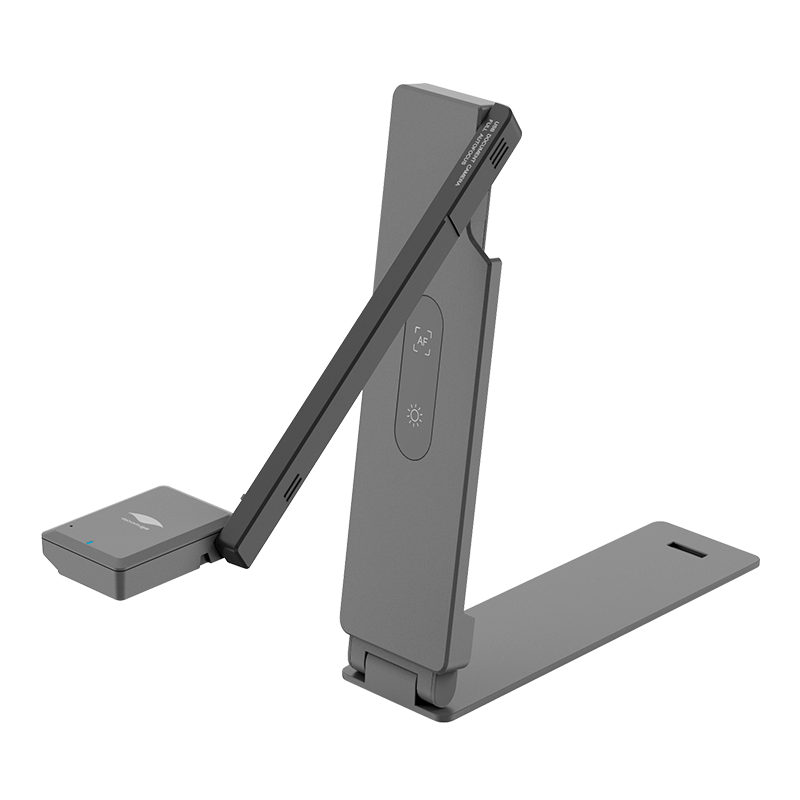
ELOAM VE1020A3AF 3-in-1 A3 8MP USB Document Camera Scanner Visualizer
A three-in-one A3 visualizer that works as a document camera, a flat-scan alternative and a webcam. The 8MP sensor outputs at 30 FPS so handwriting stays fluid when a teacher annotates a full A3 engineering drawing.
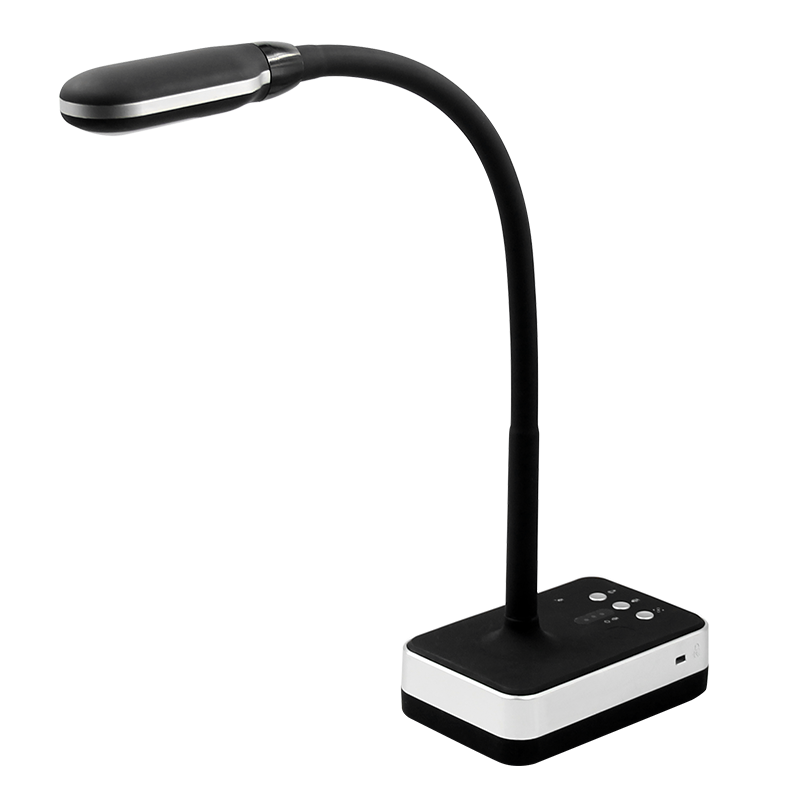
ELOAM VH1000A3AF Smart Portable USB Document Camera for Teachers
Built around the adjustability teachers actually ask for: a multi-joint flexible arm that stays exactly where it is placed, letting the head hover over a textbook page or look straight down at a demonstration bench. The fast scan path drops straight into classroom display software.
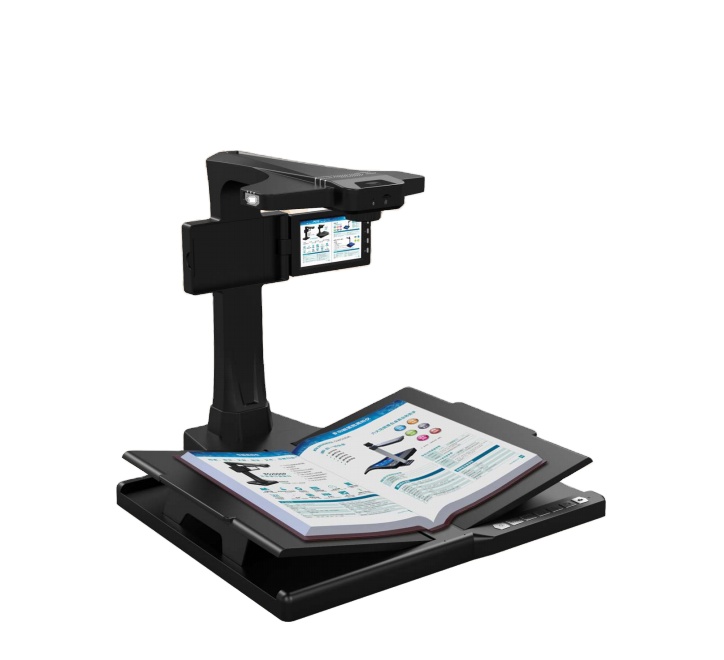
Eloam BS3000P 28MP A3 V-Shape Book Scanner with LCD Preview
A 28MP V-cradle book scanner with an on-board LCD preview screen. The cradle holds the spine near 90° and curve correction flattens residual page bow, which is why it is the default choice for digitising bound volumes in libraries and archives.
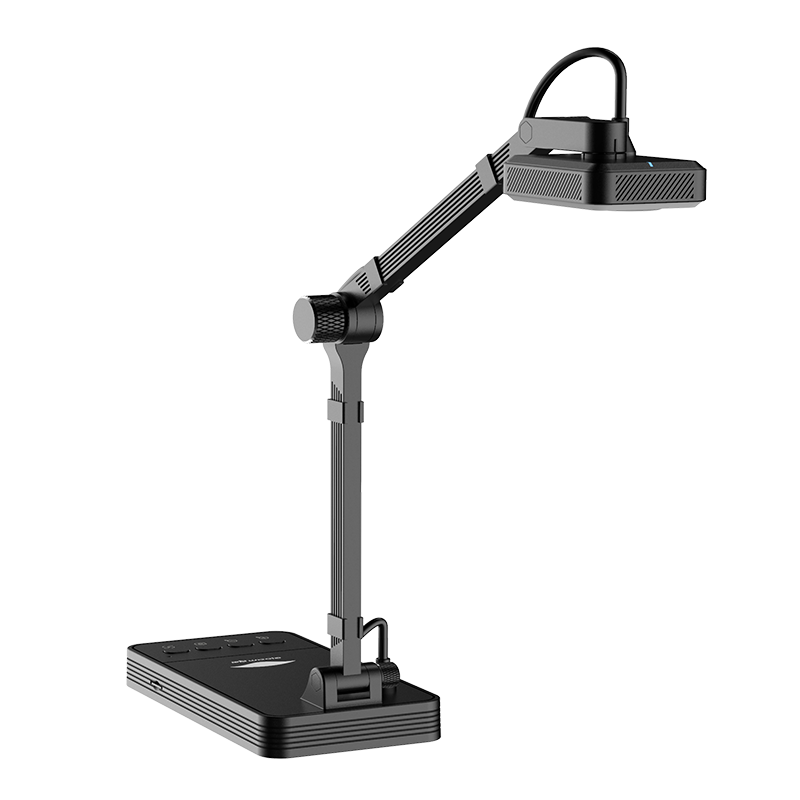
ELOAM YL1050 Wi-Fi & USB A3 10MP Document Presenter
A 10MP A3 visualizer with dual Wi-Fi and USB operation. For resellers the commercial argument is simple: a teacher can walk between desks with the camera while the image stays on the projector, with no cabling run across the classroom floor.
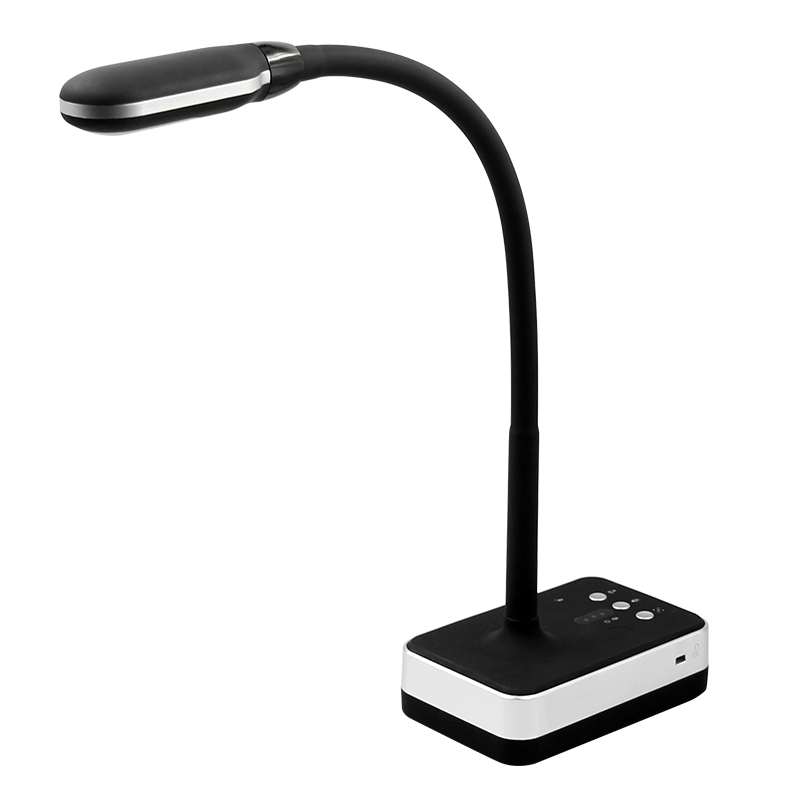
ELOAM VH800AF 8MP Foldable Overhead Document Scanner
A compact 8MP A4 overhead scanner whose arm folds into its own base. Ideal for bundling with laptops and for presentation kits that travel by air, where every centimetre of case space is charged for.
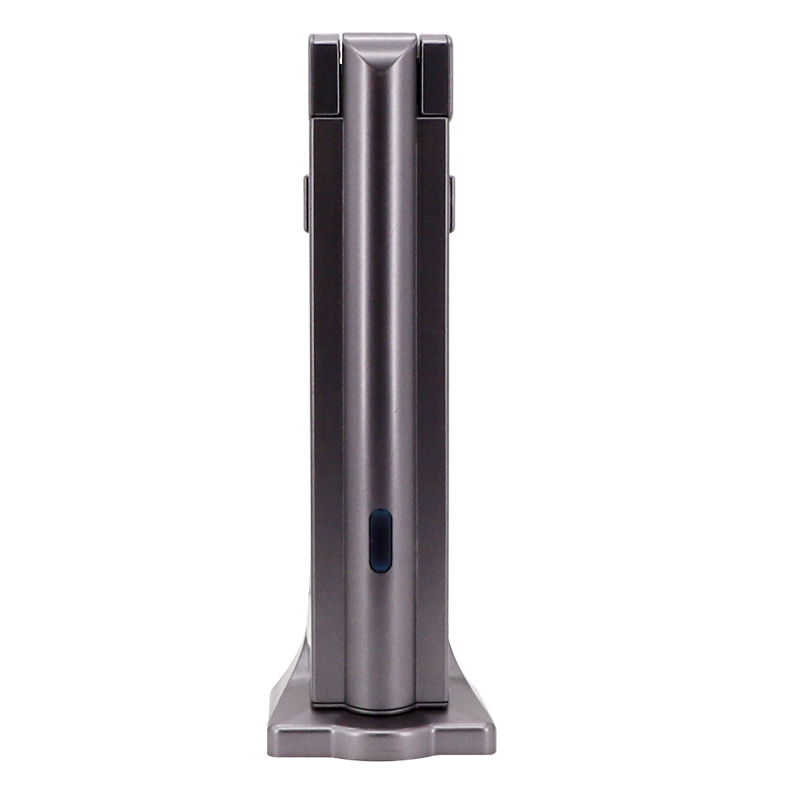
ELOAM Auto-Focus A3 10MP Portable Document Scanner
True auto-focus combined with a one-second continuous scan cycle. For operations teams processing stacks of invoices and shipping documents, that pairing removes the manual re-focus step between pages and the rework that follows it.
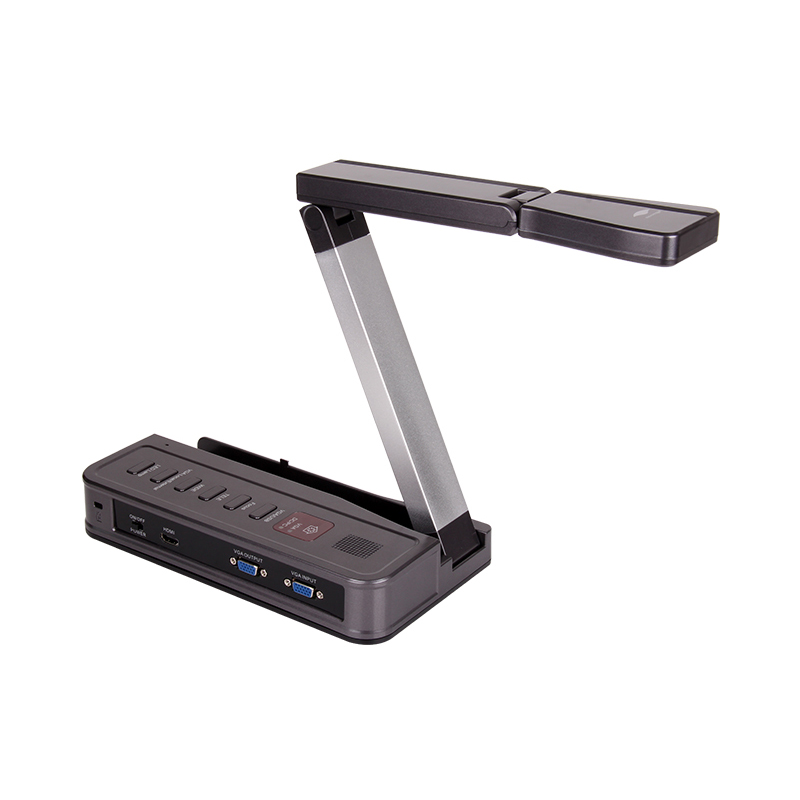
Eloam Portable A4 5MP 30FPS USB Type-C 3-in-1 Visualizer
An A4 three-in-one visualizer that draws power and data over a single USB-C cable. The 30 FPS stream is useful for sales engineers presenting to clients online who cannot justify an HDMI capture box in their bag.
What a Real Factory Customisation Programme Covers
Relabelling a carton is not ODM. Here is the six-layer scope we work through with every private-label partner.
Mechanical & Arm Design
Arm length, joint count, damping torque, base clamp versus screw mount, head rotation range and housing colour are all tooled to your brief — not selected from a fixed catalogue.
Optics & Firmware Tuning
Sensor selection, auto-focus behaviour, exposure and white-balance curves, frame rate and low-light gain are tuned per market, because a visualizer that looks correct under LED classroom lighting can look washed out under office fluorescents.
Software, OCR & SDK
Windows and macOS drivers, capture SDK, TWAIN bridges for records-management systems, and OCR output in up to 180 languages with PDF, JPEG and TIFF export on selected models.
Branding & Retail Packaging
Logo silk-screen and laser etching, colour-box artwork, multilingual quick-start guides, barcodes, energy labels and market-specific compliance marking — prepared for retail shelves or tender delivery.
Certification & Compliance
CE certification across the range, FCC on selected models, RoHS material declarations, and shipment documentation that matches the requirements of your destination customs regime.
Production & Delivery
Eight production lines with incoming, in-process and finished-goods inspection; shipping under FOB, CFR, CIF or EXW terms with a standard one-year warranty and spare-parts planning.
What Wholesale Buyers Actually Specified in 2024–2025
Share of adjustable document camera enquiries that named each requirement as mandatory, drawn from our own quotation records.
Source: internal enquiry analysis, Shenzhen Hobry Technology, 2024–2025. Percentages indicate the share of qualified B2B enquiries listing the requirement as non-negotiable.
Four Directions Shaping the Next Generation of Visualizers
Where the engineering budget is moving — useful context if you are planning a 2026 private-label range.
Hybrid Zoom Replaces Digital Zoom
Digital zoom degrades as it enlarges, which becomes obvious the moment a specimen or a circuit board is projected onto a 90-inch display. Buyers are moving toward optical and hybrid zoom heads, and are starting to write minimum optical magnification into tender documents.
One Cable, No Capture Box
VGA plus a separate capture card was the standard classroom stack for fifteen years. USB-C carrying both power and video removes two failure points from every installation, and cuts the bill of materials for the integrator as well as the support burden after handover.
On-Device Pre-Processing
Auto-crop, deskew, glare suppression and OCR are migrating from the PC into the camera itself. The commercial consequence is that the unit can deliver a clean, searchable file to a Chromebook or a thin client — a decisive advantage in managed-IT school districts.
Durability as a Published Spec
Hinge cycle rating, drop height and cable-flex life are becoming specification line items rather than marketing claims. Distributors who ask for the test data now will hold a defensible position when a competitor's friction hinge starts sagging in month nine.
Shenzhen Hobry Technology — The Factory Behind the Platform
Vertical integration is the reason customisation requests come back with engineering answers rather than sales excuses.
Founded in 2005, Shenzhen Hobry Technology Co., Ltd. began in digital video technology and grew into a specialist in high-speed portable document scanners, book scanners and document cameras. The operating model is deliberately vertical: industrial design, optics and firmware R&D, software development, manufacturing and global sales all sit under one management team, which is why an adjustability request — a longer arm, a different torque curve, a locking collar — can be answered by the people who will actually cut the tooling rather than routed through an intermediary.
As a National High-Tech Enterprise holding independent intellectual property, software copyright registrations and patents, the company combines ergonomic design with a low-carbon office philosophy to deliver reliable imaging hardware at genuine factory pricing. The factory has been verified onsite by Intertek, runs eight production lines across a facility of 5,000–10,000 m², and employs roughly 101–200 people. Principal markets are North America, Southeast Asia, Southern Europe and the Middle East, supported by five international trade exhibitions each year.
- ISO 9001
- CE Certified
- FCC (selected)
- High-Tech Enterprise
- Software Copyrights
- 1-Year Warranty
Match the Deployment Scenario to the Right Adjustable Platform
Use this matrix to shortlist two or three models before requesting samples — it shortens the evaluation cycle considerably.
| Deployment Scenario | Recommended Model | Max. Capture Area | Key Specifications | Why It Suits Wholesale |
|---|---|---|---|---|
| Hybrid classroom / distance learning | YL1050 | A3 | 10MP, 30 FPS, Wi-Fi + USB | Untethered teaching; one SKU covers both wired and wireless classrooms |
| Interactive lesson delivery | VE1020A3AF | A3 | 8MP, 30 FPS, 3-in-1 | Camera, scanner and webcam in one unit — reduces the accessory list |
| Teacher desktop / portable kit | VH1000A3AF | A3 | 8MP, flexible multi-joint arm | Adjustable head position is the feature teachers actually request |
| Bank, insurance & counter KYC | VW1000AF | A4 | High-speed OCR, USB + Wi-Fi | Compact footprint, fast onboarding of forms and identity documents |
| Field sales & travel presentations | VH800AF | A4 | 8MP, foldable overhead arm | Folds into its own base; bundles cleanly with laptops |
| Bulk invoice / records capture | AF-A3-10MP | A3 | 10MP, auto-focus, 1-second continuous scan | Continuous scanning without manual re-focus between pages |
| Library & archive digitisation | BS3000P | A3 | 28MP, V-cradle, LCD preview | Non-destructive handling of bound volumes and fragile spines |
| Single-cable demo stations | USB-C 5MP | A4 | 5MP, 30 FPS, USB-C power + data | No capture box, no power brick, no second cable to fail |
Questions Wholesale Buyers Ask Before the First Purchase Order
Are you a manufacturer or a trading company?
Can the arm, hinge torque and base be customised — not just the logo?
What is your sample policy and minimum order quantity?
Which OCR languages and operating systems are supported?
Which payment methods and delivery terms do you accept?
What certifications and warranty come with the products?
How do you handle quality control across a mixed container?
Planning an Adjustable Document Camera Range for 2026?
Send us your capture area, target market, estimated volume and any hinge or SDK requirements. Our engineers will come back with a recommended platform, a customisation path and a factory-level quotation — usually within one business day.
Inquire Now